
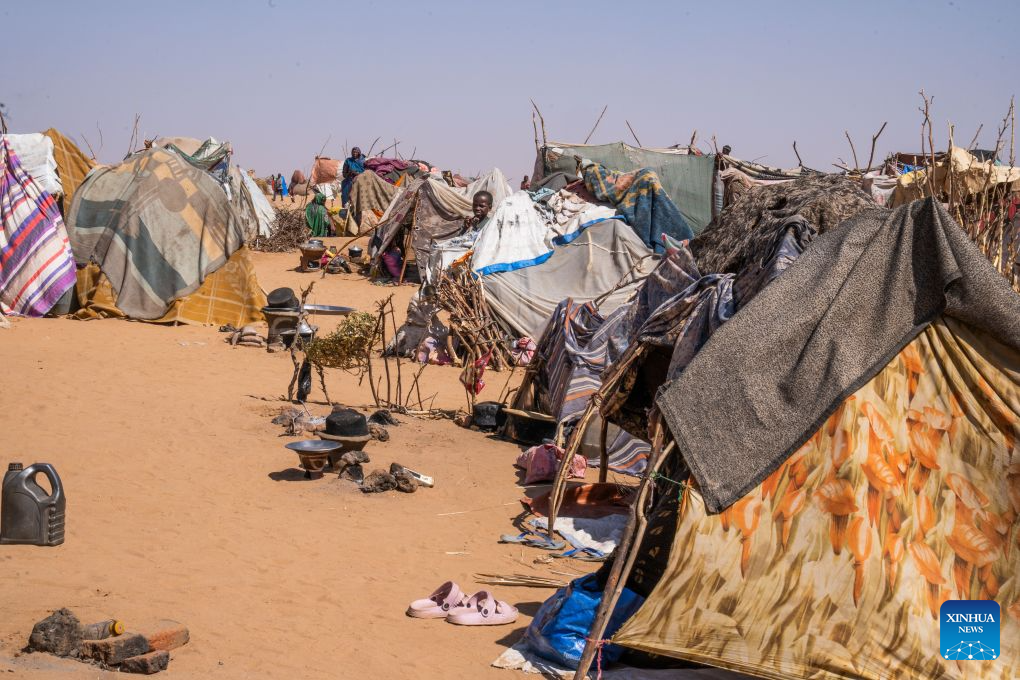
This photo taken with a mobile phone on Oct. 5, 2026 shows tents sheltering displaced people who have recently fled to the area in Tawila, Sudan. (Photo by Al-Sayed Mahmoud Ahmed/Xinhua)
KHARTOUM, Oct. 5 (Xinhua) — The civil authority of Tawila, North Darfur State in western Sudan, has called for stronger humanitarian assistance, as more than 6,000 displaced people flooded into the town since the beginning of September, with 1,394 in the past week.
In a statement, the authority, under the Sudan Liberation Movement, said on Monday that displaced families continue to arrive in search of safety despite difficult humanitarian conditions, calling for stronger humanitarian assistance, safe corridors for aid and protection of civilians.
Located about 60 km west of El Fasher, the capital of North Darfur State, Tawila is one of Darfur’s largest displacement centers, hosting more than 700,000 displaced people, according to recent United Nations (UN) data.
“260 families, comprising 1,394 people, arrived in Tawila between Sept. 28 and Oct. 4, most of them women, children and elderly people,” Adam Rijal, spokesperson for the General Coordination for Displaced Persons and Refugees in Darfur, told Xinhua.
The cumulative number of displaced people arriving in the area since Sept. 1 had reached 1,169 families, or 6,191 people, Rijal said, adding that the new displacement came amid deteriorating security and living conditions, food insecurity, drought and low rainfall, as well as worsening famine and limited basic services, particularly in eastern parts of North Darfur.
Ismail Abbakar, who fled the Al-Lait area east of El Fasher with his family following armed clashes between the Rapid Support Forces (RSF) and local armed groups, told Xinhua that worsening security was compounded by growing difficulties in obtaining food, water and other necessities.
“My priority now is to secure my children’s needs and find a means of livelihood,” he said.
Rijal warned that the continued influx is creating growing needs for food, water, medicine, shelter and healthcare, placing additional pressure on Tawila’s limited resources and services.
He appealed to humanitarian organizations and international agencies to provide food, clean water, medicines, shelter, healthcare, sanitation and psychosocial support.
Despite acute humanitarian needs, funding shortages and restricted road access are preventing international aid from reaching affected populations.
The UN World Food Programme (WFP) said in September that funding shortages threatened to reduce assistance in Sudan, where millions of people face acute food insecurity. Carl Skau, WFP acting executive director, warned that funding shortages meant the organization could provide displaced people in the area with only half of their monthly food ration, enough for about two weeks.
Relief operations also face access challenges. In April, a UN High Commissioner for Refugees aid truck traveling to Tawila was attacked by a drone, destroying supplies intended for about 1,314 families.
Sudan has been witnessing a deadly war between the Sudanese Armed Forces and the paramilitary Rapid Support Forces since April 2023.
The conflict has killed thousands and displaced millions of people inside and outside Sudan, while exacerbating the country’s humanitarian and food crises. ■
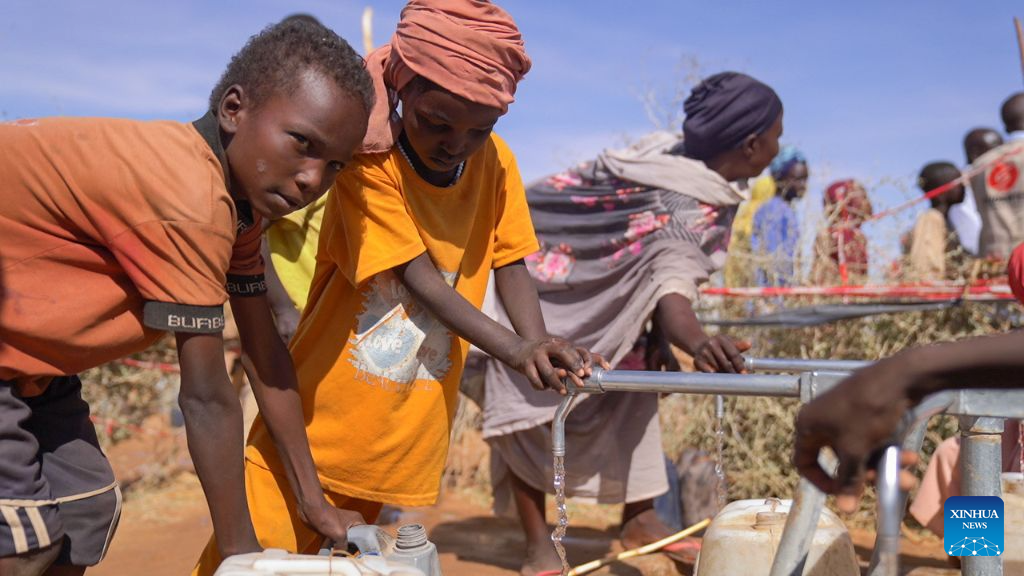
This photo taken with a mobile phone on Oct. 5, 2026 shows a group of displaced people using a hand-operated water pump to obtain water in Tawila, Sudan. (Photo by Al-Sayed Mahmoud Ahmed/Xinhua)